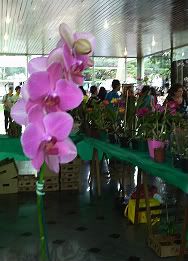
My Rainbow Orchid's - article

Showing posts with label exotic orchids. Show all posts

Sunday, October 10, 2010

The Magic Of Orchids - eBook

Dear Friend,

I want to tell you a story about a man who had a terrible case of Orchid fever. He was obsessed with Orchids. This secretive orchid hunter and cultivator devoted his life to their care and study. He read everything, tried everything, and noted everything.

He succeeded in growing many a glorious hybrid but showed neither his orchids nor his notes to anyone. Except once! Just once Anton Thuranzsky allowed his 8-year-old daughter into his orchid house to see his breathtaking collection.

When he died, his growing secrets would have died with him if his daughter had not discovered his manuscript hidden underneath a bookcase. Packed into her suitcase she took it with her as she left Hungary for her new home in the US.

Written in his native Hungarian, it took her years of painstaking work to translate, edit, test, update, and cross-reference his original writing. And now, destined to become THE AUTHORITATIVE GUIDEBOOK on orchid care, the book is finally ready.

    That’s quite a claim isn’t it: ‘THE AUTHORITATIVE GUIDEBOOK’? But, it’s true and we can prove it because if you were to try to find the information in this Amazing Resource somewhere else, you would need volumes of books and then, you still wouldn’t find the breakthrough orchid care information covered in this 210 page instantly downloadable ebook, including photos and illustrations

Here are just some of the questions this ‘Orchid Magic’ book will answer for you about orchid care.

• Is it true that anybody can grow orchids?
Answer. Yes but you'd better know which ones. Don't be fooled, some orchids are for beginners; others are for intermediate and advanced growers. Chapter 1 tells and shows you which is which. Then the book gives you the knowledge to move from beginner to advanced.

• Can I grow orchids from seed?
Answer. Yes, Chapter 10 takes you step-by-step through the fascinating process of maturing Orchids from seeds.

• What about hybrids? Does the book tell me how to grow hybrids?
Answer. Not only does it tell you, it shows you. Do you want to grow a prize-wining hybrid? Then you need to know which Orchids to use for parents. That’s covered in Chapter 12.
Did you know that some Hybrids have sold for up to $10,000.00. Maybe you can create one that will carry your name and sell for even more.

• What did Charles Darwin discover about orchids, and is that something I really need to know?
A. Not really, but you can find the answer is Chapter 2 and it makes for great conversation.

• My orchids are looking sickly what's wrong with them?
A. Is your orchid sick or merely going through a phase? Chapter 6 answers how to diagnose one from the other. If you don't have this information you can do more harm than good because some Orchids can look sick when all they’re doing is going through a growing phase.

• What do I do about Orchid pests.
A. Chapter 9 shows and tells you how detect and deal with the various pests.

• To repot or not repot, how do I know?
A. Because a mistake in misreading the signs can kill, Chapter 8 answers when and how in great detail. Also forget about all the other potting mediums because here you learn which is quite simply the perfect orchid potting medium.

• I've heard something about Rhizoctonia what is it?
A. It's a friendly fungus, and if you feed it to your orchids they'll adore you for it. On Page 149 you’ll find the formula for duplicating the fungus's actions.

• How do I know when my Orchids need rest?
A. Just like you Orchids need their rest and different orchids employ various methods for showing you that it’s their time. Chapter 8 tells you everything you need to know about orchid resting.

And that barely scratches the surface because what’s good for your Cattleya could kill your Phalaenopsis. Even certain orchids within the same type require different methods and with this book in your hands you’ll master everything from the easily grown Cypripediums to the temperamental hybrids. 

The Magic Of Orchids - eBook  = CLICK HERE !!!


Saturday, September 25, 2010

Orchid Facts and Types Recommended

Orchids are known for there exotic flowers and fascinating growing habit and this makes them a very desirable ornamental plant for enthusiasts. The Orchid family consists of some 750 genera, almost 25,000 species and more than 100,000 hybrids.

Terrestrial Orchids:

These Orchids, as the name suggests, grow in the ground in a wide and varying habitat. The Hardy or near Hardy terrestrials, that grow in colder regions, tend to have small individual flowers that form dense spikes. After flowering they tend to die down and go into a state of rest for the winter and exist as tubers or other small storage organs underground. There are some very attractive species and many are grown in rock gardens or alpine beds.

Other terrestrials, which suit warmer conditions, are very delicate so will need to be grown in a greenhouse. In the wild they would grow on the forest floor in sheltered sites. These remain evergreen throughout the year.

Epiphytic Orchids:

These Orchids make up a large proportion of Orchids that are grown by enthusiasts. There structures and habit are very much different to that of the Terrestrial Orchids, the name Epiphytic is derived from the Greek epi which means upon, and phyton which means plant. The branches of trees are where Epiphytic Orchids make there homes. They do not feed off the tree so they are not parasites but lodgers and get there food from debris around there roots and from nutrients dissolved in rain water. Some of these Orchids live in a similar manner but on rocks and these are known as lithophytes. Epiphytes need to be grown under glass or in a conservatory.

Recommended Orchids:

Miltonia candida

Vanda Rothschildiana

Cattleya bowringiana

Cymbidium Strath Kanaid

Paphiopedilum callosum

Dendrobium nobile

When choosing your plants it is always best to buy them from a specialist Orchid nursery. They can offer valuable advice on suitable species to suit your growing conditions at home.

Alexander website Orchid Care Expert helps people learn about orchid care.

 by:  Alexander Vincent

Sunday, June 20, 2010

The History of Orchids

Most of us regard the orchid as a beautiful, exotic and romantic flower Most are also unaware of their spectacular history and the passionate efforts which have gone into finding, cataloguing and creating the orchids which we enjoy today
Most of us regard the orchid as a beautiful, exotic and romantic flower. Most are also unaware of their spectacular history and the passionate efforts which have gone into finding, cataloguing and creating the orchids which we enjoy today.

A register of orchids is held at the Royal Horticultural Society in London. The Vanilla orchid was the first to enter Europe back in 1510. This was the source for the second most expensive flavouring extract (the most expensive being the saffron crocus). Over a hundred years passed, until in 1635 when the Cypripedium reginae was imported from North America, this is when orchids were first appreciated for their decorative features. The interest in the orchid blossomed from this point onwards. However, even as late as the 1800 it was very rare to fine a collector with more than a few samples. In 1804 both the Berlin and the Paris Botanical Gardens both only held seven species of exotic orchid! The Viennese had the most with a whole eleven special which in England there were merely three exotic orchids. These low numbers were not for want of trying, countries were importing orchids all the time, however, they were dying in transit, or not being kept in conditions which allowed for the plants to survive their new climates.

Jean Linden was instrumental in increasing our knowledge of orchids, when in 1845 he travelled to South and Central America to study the orchids? natural environment. The reports which Linden wrote were crucial in the recreation of the moist environments which we now associate with most orchids.

Many of the early entrepreneurs who thought that this would be the way to make their millions were cut short in their ventures as they experienced huge losses as a result of the number of orchids not surviving the initial journeys. There were only four successful companies in Britain, one of them being Sanders, who continued to grow in the orchid market for many years afterwards.

In the early nineteenth century Dr Salisbury studied the germination of the orchid and from this much was learnt which enabled the industry to progress and many of the orchids which were imported suddenly became a more viable investment. With this new knowledge a gardener working for Veitch first tried to cross different orchid species in 1853. It was not until 1856 that the first orchid hybrid was created. From this time on many more hybrids were to be created. Mr Dominy who managed this probably had no idea how important this was and how it would change the future of orchid cultivation. To this day the perfect black orchid is still being sort after and is still illusive.

Today the special and rare qualities of the orchid are appreciated. In many areas there are species of orchid which are considered endangered and you can be prosecuted for picking or damaging these in any way. Some orchids are definitely for viewing only. The orchid family is the largest flower family known and will continue to grow with hybrids being created each year.Jon Kelly is a published author who writes on many diverse subjects that includes advice and tips on Orchids. We hope to provide you with informative articles you can rely on. To find out more please visit: theorchidguide.com

Popular Posts