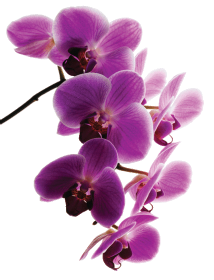
Most of us regard the orchid as a beautiful, exotic and romantic flower. Most are also unaware of their spectacular history and the passionate efforts which have gone into finding, cataloguing and creating the orchids which we enjoy today.
A register of orchids is held at the Royal Horticultural Society in London. The Vanilla orchid was the first to enter Europe back in 1510. This was the source for the second most expensive flavouring extract (the most expensive being the saffron crocus). Over a hundred years passed, until in 1635 when the Cypripedium reginae was imported from North America, this is when orchids were first appreciated for their decorative features. The interest in the orchid blossomed from this point onwards. However, even as late as the 1800 it was very rare to fine a collector with more than a few samples. In 1804 both the Berlin and the Paris Botanical Gardens both only held seven species of exotic orchid! The Viennese had the most with a whole eleven special which in England there were merely three exotic orchids. These low numbers were not for want of trying, countries were importing orchids all the time, however, they were dying in transit, or not being kept in conditions which allowed for the plants to survive their new climates.
Jean Linden was instrumental in increasing our knowledge of orchids, when in 1845 he travelled to South and Central America to study the orchids? natural environment. The reports which Linden wrote were crucial in the recreation of the moist environments which we now associate with most orchids.
Many of the early entrepreneurs who thought that this would be the way to make their millions were cut short in their ventures as they experienced huge losses as a result of the number of orchids not surviving the initial journeys. There were only four successful companies in Britain, one of them being Sanders, who continued to grow in the orchid market for many years afterwards.
In the early nineteenth century Dr Salisbury studied the germination of the orchid and from this much was learnt which enabled the industry to progress and many of the orchids which were imported suddenly became a more viable investment. With this new knowledge a gardener working for Veitch first tried to cross different orchid species in 1853. It was not until 1856 that the first orchid hybrid was created. From this time on many more hybrids were to be created. Mr Dominy who managed this probably had no idea how important this was and how it would change the future of orchid cultivation. To this day the perfect black orchid is still being sort after and is still illusive.
Today the special and rare qualities of the orchid are appreciated. In many areas there are species of orchid which are considered endangered and you can be prosecuted for picking or damaging these in any way. Some orchids are definitely for viewing only. The orchid family is the largest flower family known and will continue to grow with hybrids being created each year.Jon Kelly is a published author who writes on many diverse subjects that includes advice and tips on Orchids. We hope to provide you with informative articles you can rely on. To find out more please visit: theorchidguide.com