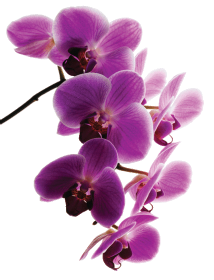
My Rainbow Orchid's - article

Showing posts with label orchids. Show all posts

Thursday, December 2, 2010

Varieties and Types of Orchids (2)


Another classification for orchids is those depending on the design or shape of their petals. For instance, the "moth orchids" or the Phalaenopsis orchid takes its name from the shape of its petals which resembles a moth diplaying his wings. The Phalaenopsis is probably the most common types that you can find and buy at the local grocery or garden store. Pink or pinkish is the most popular color for this species that is why some fashion designers have named such color as "orchid" which is of course,rather confusing since pink is not just the common color of all orchids. Wild Phalaenopsis are epiphytes, and usually grow on trees.


Another type of orchid which is also rather very popular is the Dendrobium. These are the type that are displayed in hotels and massage parlors for that "oriental" and relaxed atmosphere. The Dendrobium comes in many colors such as white, green, purple, pink, yellow, and some with combinations of such colors. Dendrobium is one of the largest orchid genera. These species live as epiphytes and lithophytes in New Zealand, Tahiti, New Guinea, Southern China, Thailand (where it is very famous), Japan and Australia.

Slipper Orchids are another type. Slipper orchids have strange appearances and there are no other types of flowers which are similar to them. Their petals have pouch-shaped lips. These orchids are terrestial. There are four genera included in this classification. They are the Paphiopedilum,Phragmipedium, Cypripedium and selenepidium. These varieties are usually hard to grow except for the Paphiopedilum which you can readily buy at orchid stores.

There is an orchid which seems to grow best in Southern California. This is the Cymbidium, more popularly known as the "Boat orchid". These are probably the most popular orchid in painting history since it is said that depictions of such flowers date back to the time of Confucius. Their petals are probably easy to paint due to its size and "showy" arrangement. The types of orchids do not stop here, as there are 700 or more genera, but these are the most popular among the types of orchids.


Author: Marty Lewis

Friday, November 19, 2010

Orchids That Are Easy To Grow Indoors (1)

Orchids That Are Easy To Grow Indoors (1)

The increasing awareness that orchids can be grown successfully indoors has resulted in the increase in their popularity. Initially, let's review three of the popular orchid varieties that are considered to be easy to grow, together with some of their individual characteristics: Orchid Varieties and Care Requirements The following orchids are varieties of the epiphytic species which are noted for growing from the bark of trees in tropical and sub-tropical areas. Phalaenopsis Orchid, otherwise known as Moth Orchid, is a variety which has undergone cross-pollination, producing hybrids with a reputation for being able to adapt to an indoor environment. This cross-pollinating has also resulted in a wide selection of flower colours in both white tints and more defined colours. The leaves of this particular orchid type are thick and fleshy, while its blooms remain in flower from two to three months.

Cattleyas Orchid is an orchid species recognised for its beautiful colourful flowers in a wide range of colours. Generally considered to be the instantly recognisable orchid image, this plant's blooms feature a variety of markings with the petal having a frilly edge. Each orchid's blooms remain in flower for up to four weeks. Oncidium Orchid, also recognised as Dancing Lady Orchid is versatile in its tolerance to different growing conditions, particularly with regard to cooler temperatures. The blooms from this orchid range in both size and colour of flower, and will thrive within an indoor environment.

Orchid Fragrance is one characteristic that is enjoyed by all who grow and enjoy their orchid plants aE" these growers consider that no other group of floral plants produce a range of scents which can compare with the subtle aromas of the orchid family. Orchid Care When it comes to caring for orchid plants, the provision of the following basic requirements will ensure that the orchids will continue to flourish.  Read More...........(2)


Published by: Ian Pengelly

Cattleya Orchid: Factors to Keep in Mind During Their Plantation!

Cattleya orchids are special types of orchids that look a very rich and grand appearance and please everyone's heart. Hence, they are chosen for some of the prominent occasions such as corsages and others.

You may witness, different varieties of habitat of cattleya orchids. Born in the Central America, these flowers are known to have a prominent presence all over the Amazon region. You may find some of the endangered varieties of cattleya in the region that looks simply beautiful and amazing. They look favorable in many occasions and amuse the receiver with their great looks.

These flowers mainly have a strong 'pseudo bulbs' which is topped over velvety leaves. Every year, a new shoot grows on the dormant bud and thickens the existing pseudo bulb. Soon after, a fresh flower comes into existence in many different colors from purple, pink to even white. Also, you can get green-colored cattleya orchids as well.

Hybrids:
Nowadays, many hybrids varieties have been developed over the years. Some of these can be easily grow and flower. Many of great varieties such as Sophronitis and Brassovola are the hybrid varieties of cattleya.


by.Jack Martinwood

Sunday, October 31, 2010

Top 5 Tips For Growing Orchids for Dummies

With the popular belief that orchids are very hard to look after, most people that enjoy them for their stunning beauty and extraordinary elegance are scared to grow and look after their own. They will admire them from afar but are a bit wary to have their own collection. This growing orchid
for dummies article will let help you learn orchid's basics and hopefully stop you from fearing growing orchids of your own.

Growing Orchids For Dummies Tip #1

Start by choosing an orchid that is relatively easy to grow since you are a beginner. With over 20,000 species of orchids and not including the hybrids, it is safe to say that there is an orchid that you can look after. The Phalaenopsis variety is fairly easy to take care of. They are one of the most popular kinds in the orchid family. Most people buy them for gift giving and most groceries and nurseries have them. They are suited to survive in the home environment and do not need many special requirements apart from the basics.

Before you purchase an orchid, thoroughly check out the plant first to ensure you have a healthy orchid. You do not want to buy something that is sick because if the plant dies, you will think it is your fault and be discouraged to try again and look after another one. Select an orchid with unblemished and light green leaves and that the plant is securely in place in its pot.

Growing Orchids For Dummies Tip #2

Orchids do not grow in regular soil. In the rainforests where most orchids originate from, they attach themselves on the trees and rocks so that they can grow without restrains and that their roots are able to breath. It is an orchid 101 basic that you plant your orchids in potting mixes such as tree back, charcoal, moss and wood chips for a healthy plant. Find out from the original orchid grower the best suitable potting mix for the type of orchid you purchased.

Growing Orchids For Dummies Tip #3

Orchids love light. It is one of their basic requirements in able to grow into healthy and beautiful orchids. The best light for orchids is sunlight during the morning. Be sure to place your orchids where this is possible. Do not let your orchids receive direct midday sunlight as the ray during this time is very harsh on them. It will singe the leaves and eventually lead to your orchid's death.

If you opt for artificial light as a substitute for sunlight, make sure to place them 2 feet above your orchid. To check if your orchid is getting the right amount of light it needs, look at the color of the leaves. Light green color means your orchid is healthy, too dark of a color means not enough and yellowish to brown means that the light you provide is too much.

Growing Orchids For Dummies Tip #4

Too much water will make your orchid suffer and eventually lead to its early death. Orchids need to be watered only once or every 5 days depending on the variety. Before watering your orchid, check the pot to see if it is dry. You can test by sticking a pencil inside the pot and if the pencil is moist then there is no need to water the plant.

Growing Orchids For Dummies Tip #5
Orchids are surprising tough plants. They can stand withstand moderate variations of temperatures. The most suitable temperature however for orchids are those in the range of 60-70 degrees Fahrenheit. With this temperature, your orchid is ensured to flower during blooming season.

This growing orchid for dummies article will set you up with the basic knowledge on how to take care of your orchids. Find out as much as you can about the special requirements of your orchid to develop your beginner skills to expert orchid grower quickly.

For more valuable orchids information, please visit Orchid Growing Secrets where you will find great insights and many tips on orchid growing. Be sure to sign up for our Free Orchid Growing Mini-Course.


from articlebase

Sunday, October 3, 2010

6 Tips to Make Your Orchids Bloom Healthily

Taking care of orchids is not a very demanding job. Once you know what to check and what to do, you can actually leave the plant to bloom healthily. Like any other plants, there are important things that you have to keep in mind to make your orchid growing successful. There are also some mistakes to avoid to help you make your plants bloom well.

If you plan to take care and grow orchids at home, here are some tips that you might find useful. - tips - tips - tips -

1st tips - Do not plant your orchids on the ground. Orchids grow in rocks and on trees, thus you will never get to grow an orchid if you plant in on the soil or pot it with soil. Although this is the case, you may also need to have a potting medium to allow them to grow healthily. Coconut husk chips or fiber, tree bark, granular charcoal and tree fern fiber are just a few of the medium that you can use in potting your orchids.

2nd tips -. Do not over water your orchid plants. One sure way that can kill your orchid plants is to over water it. Taking care of orchids means learning how to determine if the plant needs watering or not. Keep in mind that some varieties may absorb water longer, so you have to also check out if the medium is dry until the roots to water it again. It is important to note also that too much dryness can be a lot better for orchids than too much wetness. Keep in mind not to water your orchids at night as well.

3th tips - . Keep your orchid away from direct sunlight. It may be helpful to take note that orchids love sunlight, but too much sunlight may burn the plants and kill them. Watch out for the discoloration of the leaves. A reddish to yellowish discoloration of the leaves may mean too much direct sunlight, thus you may want to find other locations best suited for your plants.

4th tips - . Put your orchids in a place where it can experience a difference in temperature. One tip is to place your plants near the window where it can get a good amount of sunlight in the morning and a change of temperature in the evening. A change in temperature can often trigger orchids to bloom, thus consider this as well in taking care of orchids.

5th tips - . Maintain low humidity for your plants. This will allow them to absorb water from the air, but if your indoor atmosphere does not permit your orchids to get enough from the humidity, you can also control humidity by creating a humidity tray. If you have other houseplants indoors, and they thrive well, the humidity may be good for your orchids as well.

6th tips -. Overcrowding is another thing that you have to watch out for in taking care of orchids. These plants do not grow and blossom well if they are to overcrowded in the medium, thus you have to do repotting once in a while to give them enough space to grow healthily.

By :  Carolyn Anderson 

Sunday, June 20, 2010

The History of Orchids

Most of us regard the orchid as a beautiful, exotic and romantic flower Most are also unaware of their spectacular history and the passionate efforts which have gone into finding, cataloguing and creating the orchids which we enjoy today
Most of us regard the orchid as a beautiful, exotic and romantic flower. Most are also unaware of their spectacular history and the passionate efforts which have gone into finding, cataloguing and creating the orchids which we enjoy today.

A register of orchids is held at the Royal Horticultural Society in London. The Vanilla orchid was the first to enter Europe back in 1510. This was the source for the second most expensive flavouring extract (the most expensive being the saffron crocus). Over a hundred years passed, until in 1635 when the Cypripedium reginae was imported from North America, this is when orchids were first appreciated for their decorative features. The interest in the orchid blossomed from this point onwards. However, even as late as the 1800 it was very rare to fine a collector with more than a few samples. In 1804 both the Berlin and the Paris Botanical Gardens both only held seven species of exotic orchid! The Viennese had the most with a whole eleven special which in England there were merely three exotic orchids. These low numbers were not for want of trying, countries were importing orchids all the time, however, they were dying in transit, or not being kept in conditions which allowed for the plants to survive their new climates.

Jean Linden was instrumental in increasing our knowledge of orchids, when in 1845 he travelled to South and Central America to study the orchids? natural environment. The reports which Linden wrote were crucial in the recreation of the moist environments which we now associate with most orchids.

Many of the early entrepreneurs who thought that this would be the way to make their millions were cut short in their ventures as they experienced huge losses as a result of the number of orchids not surviving the initial journeys. There were only four successful companies in Britain, one of them being Sanders, who continued to grow in the orchid market for many years afterwards.

In the early nineteenth century Dr Salisbury studied the germination of the orchid and from this much was learnt which enabled the industry to progress and many of the orchids which were imported suddenly became a more viable investment. With this new knowledge a gardener working for Veitch first tried to cross different orchid species in 1853. It was not until 1856 that the first orchid hybrid was created. From this time on many more hybrids were to be created. Mr Dominy who managed this probably had no idea how important this was and how it would change the future of orchid cultivation. To this day the perfect black orchid is still being sort after and is still illusive.

Today the special and rare qualities of the orchid are appreciated. In many areas there are species of orchid which are considered endangered and you can be prosecuted for picking or damaging these in any way. Some orchids are definitely for viewing only. The orchid family is the largest flower family known and will continue to grow with hybrids being created each year.Jon Kelly is a published author who writes on many diverse subjects that includes advice and tips on Orchids. We hope to provide you with informative articles you can rely on. To find out more please visit: theorchidguide.com

Saturday, June 12, 2010

All About Orchids

The orchid flower comes from a very diverse and the largest flowering family on the planet. It is also one of the oldest, 100 million years or soorchids have been growing on earth. This reason plus they are very versatile has enabled many species to multiple and multiple. It is believed that there are more the 35,000 species of orchid. There are also many more hybrid varieties of this wonderful flower family.

Although orchids have been around for a while they are still very popular. In fact, in recent years the have become more and more popular. They were first cultivated a few centuries ago although there beauty has been appreciated much longer than that. The Chinese and Japanese cultures were writing aboutorchids a few thousand years ago. Up the 20th century orchid cultivation remained in the spheres of the wealthy. In England, the aristocracy were keen orchid growers ever since the first global traders brought them back from the far corners of the world.

Everybody knows that vanilla comes from a plant. You may be surprised to know that it is actually an orchid where vanilla is derived, the planifolia to give it its correct name. Vanilla is solely grown for its commercial value as opposed to most otherorchids which are very beautiful plants and grown for their beauty. Many farmers around the world grow the orchid crop just for the vanilla seeds.

There are many orchid fanatics around due to the beauty of the orchid flower. It is not only humans that appreciate orchids, insects are attracted to orchids which in turn assists in reproduction.

There are flying insects such as bees which attracted into the pollinia of one particular orchid. The Bee Orchid looks very much like a female bee. The male be believes it is approaching a female when it is in fact assisting in the pollination process.

Here are some other examples of how orchids have evolved to reproduce:

Orchids with long stems that dance in the wind which look like butterflies.

Practical orchids which have landing platforms for insects to rest.

Orchids with slippery surfaces which insects slip on and fall into the flower ensuring nectar is brushed into the pollina.

The Angreacum Sesquipidales emits a scent to attract moths. In fact, Darwin wrote about this particular orchid. He predicted that a moth would be the insect to pollinate this orchid because the white flowered orchid emitted its scent at night.

Nigel owns OrchidCareExpert, a website which contains lots of useful information if you wish to know more about orchid care orchid care.

by:   Nigel Howell

Popular Posts